Outdoor transmission structures must remain stable under changing humidity, rainfall, wind, salt exposure, and industrial atmospheric conditions. A suitable tower therefore requires more than adequate structural strength. Steel grade, hot-dip galvanizing, zinc thickness, tower geometry, hardware protection, design standards, and installation requirements all influence the suitability of a tower for a particular site.
Table of Contents
A Weather Resistant Galvanized Angle Steel Tower combines a conventional lattice angle-steel structure with hot-dip galvanizing designed for outdoor exposure. The selection process should focus on the actual environment, voltage class, tower configuration, steel grade, zinc coating requirements, and applicable design standards rather than relying on a single specification.
What Should Be Checked Before Selection?
Tower selection starts with the conditions under which the structure will operate. Transmission towers can be installed in coastal areas, industrial zones, humid regions, open terrain, or other locations where atmospheric exposure varies considerably.
Identify the Operating Environment
- Determine whether the installation site is coastal, inland, tropical, industrial, or exposed to high humidity.
- Check the potential presence of salt, moisture, industrial emissions, or other corrosive atmospheric conditions.
- Establish the required voltage class and tower configuration.
- Review the expected mechanical loads, conductor arrangement, and tower height.
- Confirm the required national or international design standards before fabrication.
These factors influence the steel section, tower geometry, zinc coating specification, hardware selection, and structural calculations. Defining them at the beginning helps keep the tower design consistent with the actual installation conditions.
Consider the Tower Configuration
Angle-steel lattice towers can be configured as suspension, tension, angle, or terminal structures. Each configuration has a different role within a transmission line and therefore requires an appropriate structural arrangement.
Why Is Hot-Dip Galvanizing Important?
Steel exposed to moisture and atmospheric contaminants can gradually corrode. Hot-dip galvanizing places a zinc coating over the steel surface, creating a protective barrier between the steel and the surrounding environment.
Two Protection Mechanisms
- The zinc layer separates the underlying steel from direct contact with moisture and oxygen.
- Zinc provides sacrificial protection when localized surface damage exposes the steel beneath the coating.
- A properly formed galvanized layer provides more than a simple painted surface film.
- Galvanized bolts, nuts, and washers help maintain consistent corrosion protection across the assembled structure.
The product specification on the referenced page uses hot-dip galvanizing according to ISO 1461 and GB/T 2694, with an 85 μm minimum zinc coating and thicker 110–120 μm coating options for more corrosive zones. :contentReference[oaicite:0]{index=0}
Why Coating Coverage Matters
Protection should not be considered only on large flat steel surfaces. Tower members contain edges, holes, connection points, bolts, and other areas that also need suitable zinc coverage. Consistent treatment across these components helps maintain the protective system after assembly.
How Does the Tower Structure Affect Performance?
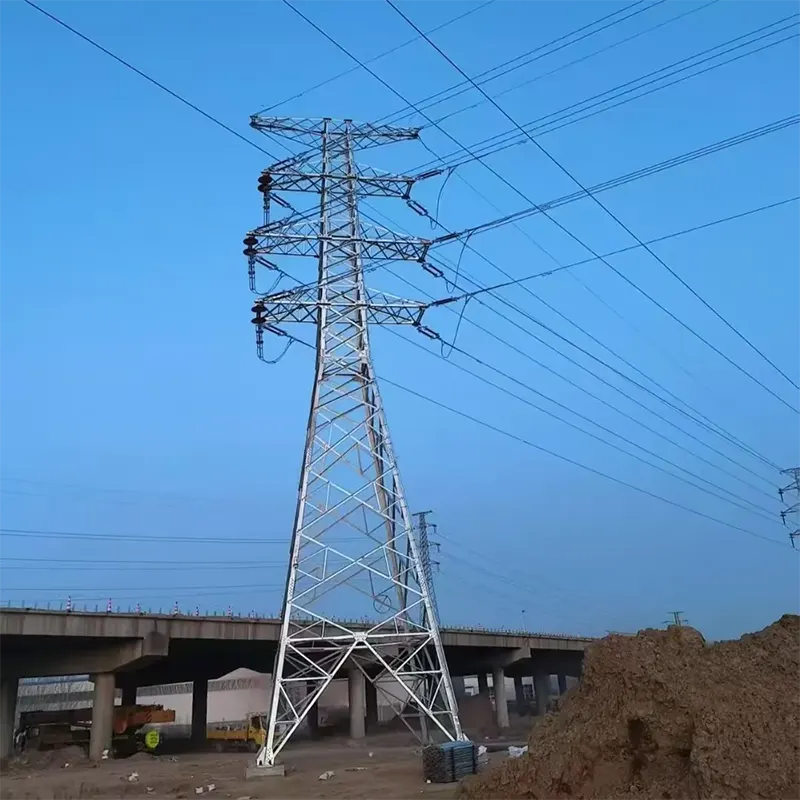
A lattice tower transfers loads through a network of main legs, bracing members, cross-arms, and connection hardware. The geometry allows the structure to achieve substantial strength while maintaining a relatively open framework.
Main Structural Components
- Main legs: High-strength angle sections form the primary vertical load-carrying members.
- Cross bracing: X or K arrangements connect the main legs and help distribute structural loads.
- Cross-arms: These components provide support for conductors according to the transmission-line arrangement.
- Connection hardware: Galvanized high-strength bolts, nuts, and washers join the structural members.
- Foundation connection: The lower tower members transfer structural forces into the foundation system.
The referenced product specification lists Q355 and Q420 high-strength angle steel for the main legs, with galvanized high-strength bolts in 8.8 and 10.9 grades. :contentReference[oaicite:1]{index=1}
Structure and Environmental Protection Work Together
Structural strength and corrosion protection should be evaluated together. A strong lattice arrangement does not remove the need for suitable surface protection, while a thick zinc coating cannot compensate for an incorrectly designed structural system. The two aspects serve different functions and must be coordinated during engineering.
Which Specifications Need Attention?
Technical specifications provide a practical way to compare tower configurations and confirm whether a proposed structure matches the requirements of a transmission project.
| Specification | Listed Range or Requirement | Why It Matters |
|---|---|---|
| Tower Type | Lattice angle steel; suspension, tension, angle, or terminal | Defines the structural role within the line. |
| Voltage Class | 66 kV–500 kV according to design | Determines electrical and structural design requirements. |
| Main Leg Steel | Q355 / Q420 high-strength angle steel | Provides the primary structural framework. |
| Galvanizing Standard | ISO 1461 / GB/T 2694 | Defines the applicable hot-dip galvanizing requirements. |
| Zinc Coating | 85 μm minimum; 110–120 μm for corrosive zones | Provides a specified level of atmospheric protection. |
| Height | 20 m–80 m | Allows the structure to be configured for different line requirements. |
| Design Standards | IEC 60652, GB 50545, BS EN 50341 | Provides the engineering framework for structural design. |
The listed product data provides a useful starting point, but the final tower configuration should be determined from project-specific loading, conductor arrangement, site conditions, applicable standards, and engineering calculations. :contentReference[oaicite:2]{index=2}
Where Can This Tower Be Used?
The galvanized lattice configuration is suitable for transmission and power infrastructure where outdoor exposure and structural stability are important considerations. Its application range can include locations with different atmospheric conditions.
Coastal and High-Humidity Areas
Coastal locations can expose steel structures to moisture and airborne salt. For such environments, the referenced specification provides thicker zinc coating options and considers additional corrosion protection requirements. :contentReference[oaicite:3]{index=3}
Industrial Areas
Industrial atmospheric conditions can place additional demands on exposed steel structures. Selecting an appropriate galvanizing specification and structural material helps address these environmental conditions as part of the overall tower design.
Transmission and Renewable Energy Infrastructure
The tower can be configured for transmission lines, utility distribution and sub-transmission systems, as well as renewable energy projects requiring outdoor steel structures. The actual tower type and dimensions should follow the electrical and structural requirements of each project.
What Should Be Checked During Manufacturing?
Manufacturing quality involves more than cutting steel members. Precision fabrication, hole positioning, member identification, trial assembly, galvanizing, coating inspection, and packing all contribute to the final structure.
- Steel preparation: Confirm the specified steel grade and prepare members according to the approved drawings.
- Cutting and punching: Process members to the required dimensions and connection-hole positions.
- Trial assembly: Assemble each tower type before galvanizing to check member compatibility and connection arrangement.
- Surface treatment: Degrease, pickle, flux, immerse in molten zinc, and complete the required finishing process.
- Coating inspection: Measure zinc thickness at multiple points and inspect coating condition.
- Repair and packing: Repair suitable damaged areas with zinc-rich coating and protect galvanized members during transportation.
The manufacturing process described for this product includes CNC cutting, precision hole punching, member tagging, trial assembly, and a multi-stage hot-dip galvanizing process. Zinc thickness is checked at multiple points, while coating adhesion and localized defects are also inspected. :contentReference[oaicite:4]{index=4}
Manufacturing Capability
Qingdao Maotong Power Equipment Co., Ltd. operates production facilities for transmission towers and related steel structures, with product capabilities covering galvanized angle towers and other power infrastructure components.
For a project-specific configuration, the important technical information includes voltage class, tower type, height, loading conditions, steel grade, galvanizing requirements, applicable standards, and site environment. These details provide the basis for developing the appropriate tower structure.
Frequently Asked Questions
What is the main purpose of galvanizing an angle steel tower?
Galvanizing protects the exposed steel from atmospheric corrosion by creating a zinc barrier and providing sacrificial protection where localized coating damage occurs.
What zinc coating thickness is available?
The listed specification provides an 85 μm minimum zinc coating, with 110–120 μm options for more corrosive environments.
Which steel grades are used for the main tower legs?
The product specification lists Q355 and Q420 high-strength angle steel for the main legs. Final material selection should follow the structural design requirements.
What voltage classes can the tower cover?
The listed product range covers 66 kV to 500 kV according to the project design. The actual configuration depends on the transmission system and structural loading.
Can the tower be used in coastal environments?
Yes. The product is designed with galvanizing options for corrosive environments, including thicker zinc coatings for sites with greater atmospheric exposure.
Which standards can be used for tower design?
The listed design standards include IEC 60652, GB 50545, and BS EN 50341. The applicable standard should be confirmed according to the project location and engineering requirements.
Choosing an outdoor transmission tower should begin with the environment, structural requirements, electrical class, and applicable standards. When these factors are defined clearly, the steel grade, lattice configuration, galvanizing specification, hardware, and manufacturing process can be coordinated as one complete structure.